How should my team approach using EQIPP? What is a typical course flow?
EQIPP is designed for the self-directed learner, and there is no "right" way to begin using EQIPP. You might begin by exploring the "lay of the land" to see what is contained on each tab:
- Home provides the course introduction.
- My Improvement Project "houses" all data collection tools and quality improvement activities.
- Clinical Guide provides relevant background information for each key clinical activity. Information includes evidence-based guidelines, scientific recommendations, best practices, related tools and resources, case studies and more.
- Resources organizes all course tools and resources in a central location.
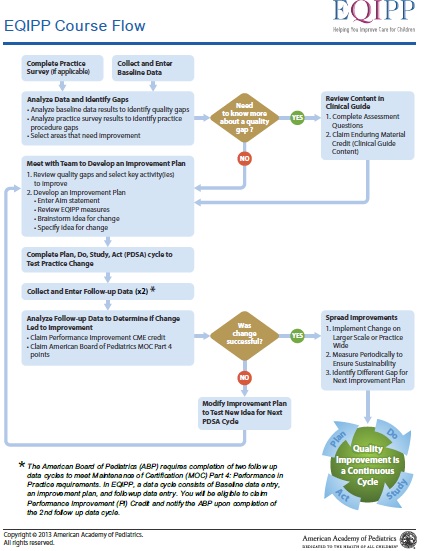
The following is an example EQIPP course flow:
How can I monitor my progression through the course?
Click Course Status in the upper right corner. A drop-down box displays a checkmark beside the My Improvement Project tasks and Assessments you have completed. If you have fulfilled CME credit requirements, the link to claim credit will be active. The last pages visited in the Clinical Guide are also indicated to help you continue working from where you left off.
I've finished entering follow-up data but am unable to analyze results or close the data cycle. How do I continue?
Go to My Improvement Project and click Collect Follow-up Data in the right navigation panel. The Patient Data Entry Status box shows the number of patients currently entered as well as the minimum number of patients that must be entered to close the data set. When are ready to close the sample data set (that is, you have entered the minimum number of patient, you intend to close the data set to future submissions, and you are ready to analyze and evaluate the results), click Close Data Set and Submit for Analysis.
What is the function of the Clinical Guide?
The Clinical Guide helps acquaint you with the key clinical activities – what they are, why they are important, and how to provide optimal care delivery. The Clinical Guide provides relevant background information and includes evidence-based guidelines, scientific recommendations, best practices, related tools and resources, and more.
What is the purpose of a baseline measurement?
To begin your quality improvement efforts in EQIPP, a baseline measurement identifies your current level of care in key clinical activities and identifies any gaps. This provides useful information for starting an improvement project. For example, after analyzing baseline data, you may choose to develop an improvement project that addresses:
- The biggest gap
- The easiest gap to bridge or close
- The gap that the team is best equipped to handle now
- The gap that the team is most motivated to bridge or close
- The gap that will yield the most success so that others will come on board with the team’s QI efforts
The possibilities, like the need for continuous practice improvement, are endless.
When and how do I do a follow-up measurement?
After creating an improvement project to address gap(s) in key clinical activities, you will work offline to conduct small tests of change through Plan, Do, Study, Act cycles. Then, go to My Improvement Project and click Collect Follow Up Data in the right navigation panel. Enter follow-up data to measure if the change(s) you tested actually resulted in an improvement.
Repeat the steps of collecting data, analyzing results to identify gaps, refining/creating an improvement project, working offline to complete PDSA cycles, and entering follow-up data until you have achieved your goals of delivering optimal newborn screening care.
What is an improvement project and how do I create one?
An improvement project recaps the 3 fundamental components of the team’s plan:
- AIM: What is the team trying to accomplish?
- MEASURES: What is being measured / how will the team know that a change is an improvement?
- CHANGES: What change(s) can the team make that will result in an improvement?
After completing a baseline or follow-up measurement, EQIPP walks you through the following sequential steps for creating an improvement project:
- Analyze data and identify gaps.
- Select the quality gaps (measures) for improvement.
- Create an aim statement.
- Develop and then specify ideas for change.
- Optionally, view and print the improvement project and then put it to work in practice. When you return to EQIPP, you will be prompted to note any progress you made with your plan.
Does EQIPP provide ideas for change based on gaps in measures?
Yes. EQIPP includes an Ideas for Closing the Gap Worksheet for each key clinical activity. It is available in Resources and is automatically available for viewing on the Specify Changes screen. In this step, you enter ideas for change describing the specific steps you will take to achieve your Aim.
How do I analyze my data?
Analysis is based on quality gaps (measures) in key clinical activities. Identify the gaps (measures) your team wants to select for improvement. Use the checkboxes on the Analyze Baseline Data page to display your data along with corresponding data from the following course subscribers:
- All
- My state
- My district,
- My group, if you registered as part of a group
Will EQIPP allow me to enter aggregate data?
If you have an EMR or patient registry that allows you to run queries and obtain the data requested by the data collection tool, you can enter the data in aggregate format on either the Collect Baseline Data or Collect Follow-up Data page.
What is QI Basics?
The Quality Improvement in Pediatric Care, or QI Basics, course is a prerequisite for all Education in Quality Improvement for Pediatric Practice (EQIPP) courses and is included with the purchase of EQIPP courses. QI Basics presents fundamental quality improvement principles and concepts, designed to help pediatric providers address the gap in health care quality - the difference between current health outcomes and those thought to be achievable using best practice models and clinical practice guidelines.
QI Basics introduces the Model for Improvement, a “tried and true” systematic framework for improving patient care, as described in The Improvement Guide: A Practical Approach to Enhancing Organization Performance.
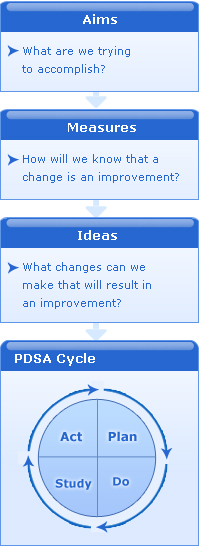
The Model for Improvement involves running small, successive tests of change through Plan, Do, Study, Act (PDSA) cycles. PDSA cycles are used to quickly test ideas for change on a small scale to help you determine if the changes lead to improvement. Successful changes can be expanded to other areas or implemented throughout your practice.
What is the role of teams in QI?
Teamwork is a fundamental skill set underlying successful medical home improvement. Developing a team is the essential first step for you to take. Evidence shows that the positive results of practice improvement, including enhanced family-centered care, occur as a product of effective teamwork.
Teamwork involves a set of skilled, cross-disciplinary interactions that are learned, practiced, and continuously improved to provide better care delivery management, promote safety, and enhance outcomes. Highly functioning teams, made up of front-line caregivers, other staff members, and fully engaged family partners, have the capacity to quickly test ideas and continuously improve on them. Such a team has and cultivates an eye for future sustainability of efforts and has the know-how to systematically integrate widespread change into the practice culture.
Teams must gain leadership support and obtain practice-wide buy-in for innovations and procedural changes, thereby ensuring success. Effective teamwork requires collaborative approaches and mutual trust. This may involve a shift from a traditional hierarchical system of practice in which organizations have emphasized individual responsibility and accountability over the collective group.
What are PDSA cycles? What do the letters stand for?
Once your team has created an improvement project that includes an idea to try out, the next step is to test whether the idea for change leads to improvement. This is accomplished using 4 equally important steps: Plan, Do, Study, and Act. The PDSA cycle is used to conduct rapid tests of change on a small scale, learn from the results, and apply the learning to the next test cycle.
The cycle links the tests of change, refining the improvement project with each iteration until the redesigned project is ready for broad-scale implementation.
What is an Aim statement?
An aim statement answers the question, What are we trying to accomplish? It articulates the results you hope to see because of the changes you make. An aim statement should be carefully worded to include a description of how much improvement is desired, the specific population that is the focus of the improvement efforts, and the amount of time it should take to achieve the aim. An aim should be based on improvements you would like to see relevant to the quality gaps you identified.
The following are some characteristics of a good aim statement:
- Clear. You and your staff should be able to read the statement and understand, without interpretation, what you are trying to accomplish.
- Numeric. The aim statement includes quantifiable measures to track progress.
- A stretch. The aim statement includes a goal set high enough so achieving it will have a significant impact on patient care.
- Focused. By referring to the aim statement regularly, people involved in an improvement effort can avoid drifting away from the intent of the improvement project. Staying focused is important so that you and your staff do not become overwhelmed or discouraged by the work.
- Flexible. The aim statement should allow the improvement team to explore multiple solutions to the gap.